A Midsummer Arabian Night's Dream

Nights 175-191
At 25 pages, this is the shortest week I’ll have for Arabian Nights. But there’s still a lot to say!
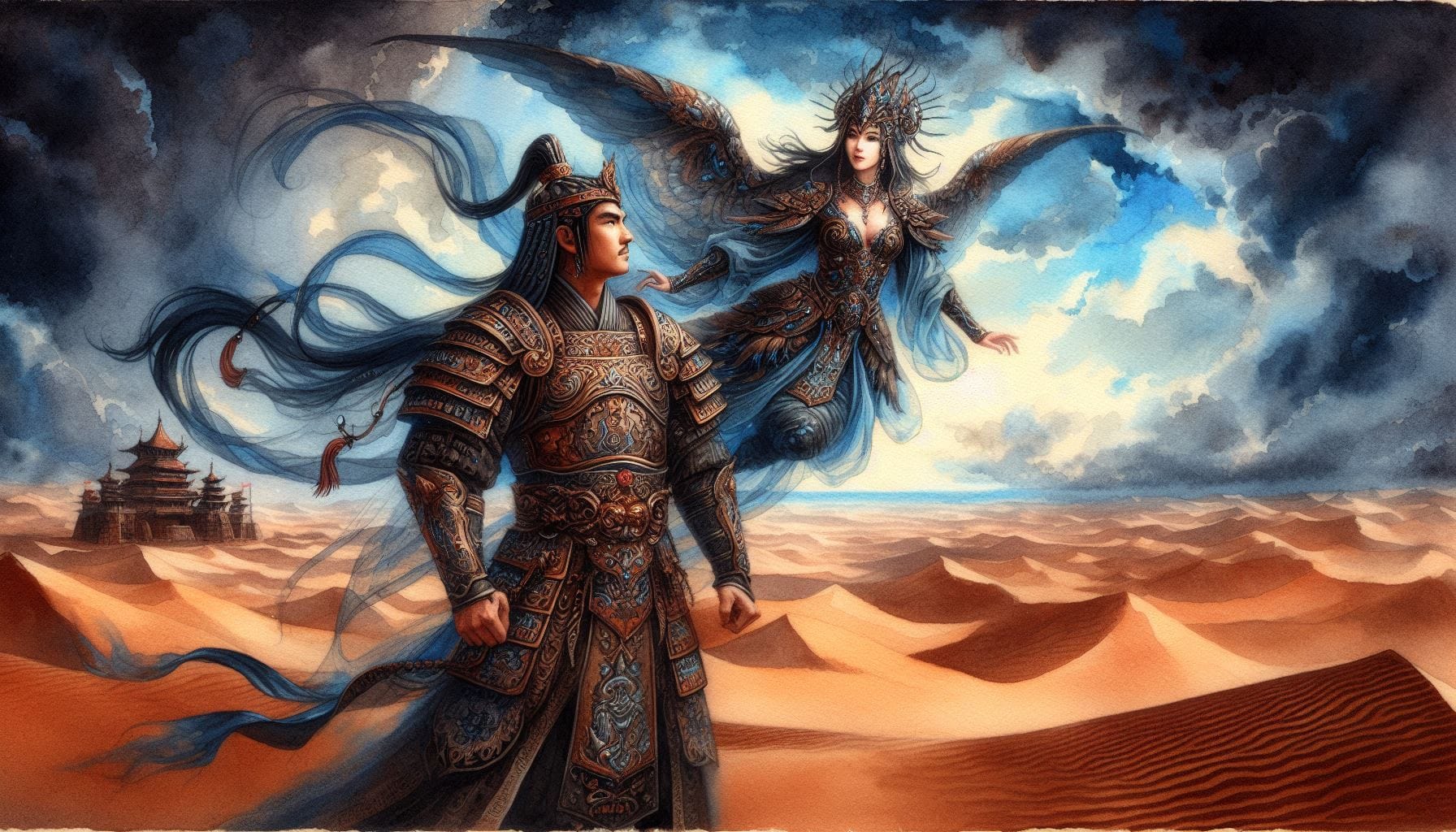
It introduced me to a favorite character so far: Qashqash the ifrit. He is one-eyed, hunchbacked, scabby, with eyes set lengthways in his face (it’s not clear how this matches up with being one-eyed, but whatever!). He’s a colorful character. He shows up when two djinns have brought a beautiful prince and princess together, sleeping, to judge which of them is more beautiful. (p. 711, night 182). The whole episode so far reminds me of A Midsummer Night’s Dream, and he could be Puck.
I liked the poems about their beauty more in this section than usual. Sometimes I find them dull, maybe I’m finally getting used to it. Or since the passage was shorter, I spent more time on it. This week, I liked the “cheeks like red anemones” (p. 715, night 184) and the “buttocks like sand dunes” (p. 704, night 178).
In the plot, the prince and princess both fall in love at first sight. They haven’t really met yet, only seen the other while the other was sleeping (thanks to djinn magic). They also get pretty handsy when exploring while exploring the other while they are sleeping. The prince opens the princess’s chemise to see her breasts “like two cakes of ivory” (night 183, p. 713). Later, when the prince sleeps, the princess’s “hand went down to his chest and then . . . his belly . . . from his navel it passed to his penis, at which her heart shook with palpitations and her lust was stirred, as lust is stronger in women than men.” (night 185, p. 716). Both of them eventually restrain themselves but in no way would you say they abide by today’s standards of consent.
One other piece I’d like to remember is the list of castles owned by the princess (p. 705, night 179): “the first is of crystal, the second of marble, the third of Chinese iron, the fourth of precious stones and jewels, the fifth of bricks, coloured stones and gems, the sixth of silver, and the seventh of gold.” The Nights have a lot of lists like that. They remind me of similar kinds of lists in the Old Testament, like the lists of birds not to be eaten in Chapter 11 of Leviticus. I find them charming, but I imagine other people just skip them.
As far as Magic cards, there is nothing new here. One of the djinns is referred to as a “marid.” I had always thought that was an aquatic creature, what with the Old Man of the Sea and the similarity to the word “marine”. But I think the water relationship may have come after the word was popularized in the West. Certainly, the marid here has no relationship to the sea. It just seems to be a derogatory term for a djinn used by another djinn. It’s not the Old Man of the Sea yet.