Roundabout Crude Words

Nights 802-831
The second half of the story is somewhat unique among the Nights in terms of plot: Our hero allies with a very ugly woman to sneak past the virgin army, confronts his wife’s antagonistic sister, acquires a hat of invisibility and a rod to summon a djinn army, watches helplessly as his wife is tortured, and finally brings his wife and children home to his mother.
I assume there were challenges in translation here, not because it was bad, just because of the extreme language. There’s lots of sex here. There’s a parade of naked virgins with “between their thighs a variety of different shapes.” (Night 806, p. 215) Both the wife and sister are called “whores” by various characters (the sister is also called a “lesbian” (Night 824, p. 248), the only time I’ve heard that). The wife appears in a “hair shirt” (Night 819, p. 236) (a better translation might be “sackcloth,” but I’m not sure; it’s supposed to humiliate her, it’s not a holy thing. They really put the humiliation on thick: she’s “tied with her own hair” (Night 819, p. 236), whipped, and finally thrown on the ground, where the slave girls “drag her out again on her face.” (Night 280, p. 238)
There is also a sexual reference in a poem that didn’t translate, so of course I looked it up: “The letters of what has bewildered me are widely known: They are four into five, and six into ten.” (Night 807, p. 216). I looked it up; it’s called an abjad puzzle, and it means 4*5 = 20 (“kaf” (ك)) and 6*10 = 60 (“sin” (س)). Combined, these make up the word for “kuss” which is basically the Arabic word for “cunt.”
The most fun translation is the ugly woman. After so many similar descriptions of beauty in the Nights, we get the ugly woman: “She was a calamity, the ugliest of all creatures, with a pockmarked face, eyebrows that had lost their hair, broken teeth, wrinkled cheeks, grey hair, mucus running from her nose and a slobbering mouth. She fitted the poet’s description: In the corners of her face are nine calamities // Any one of which gives its own view of hell . . . etc.” (Night 805, pp. 210-211)
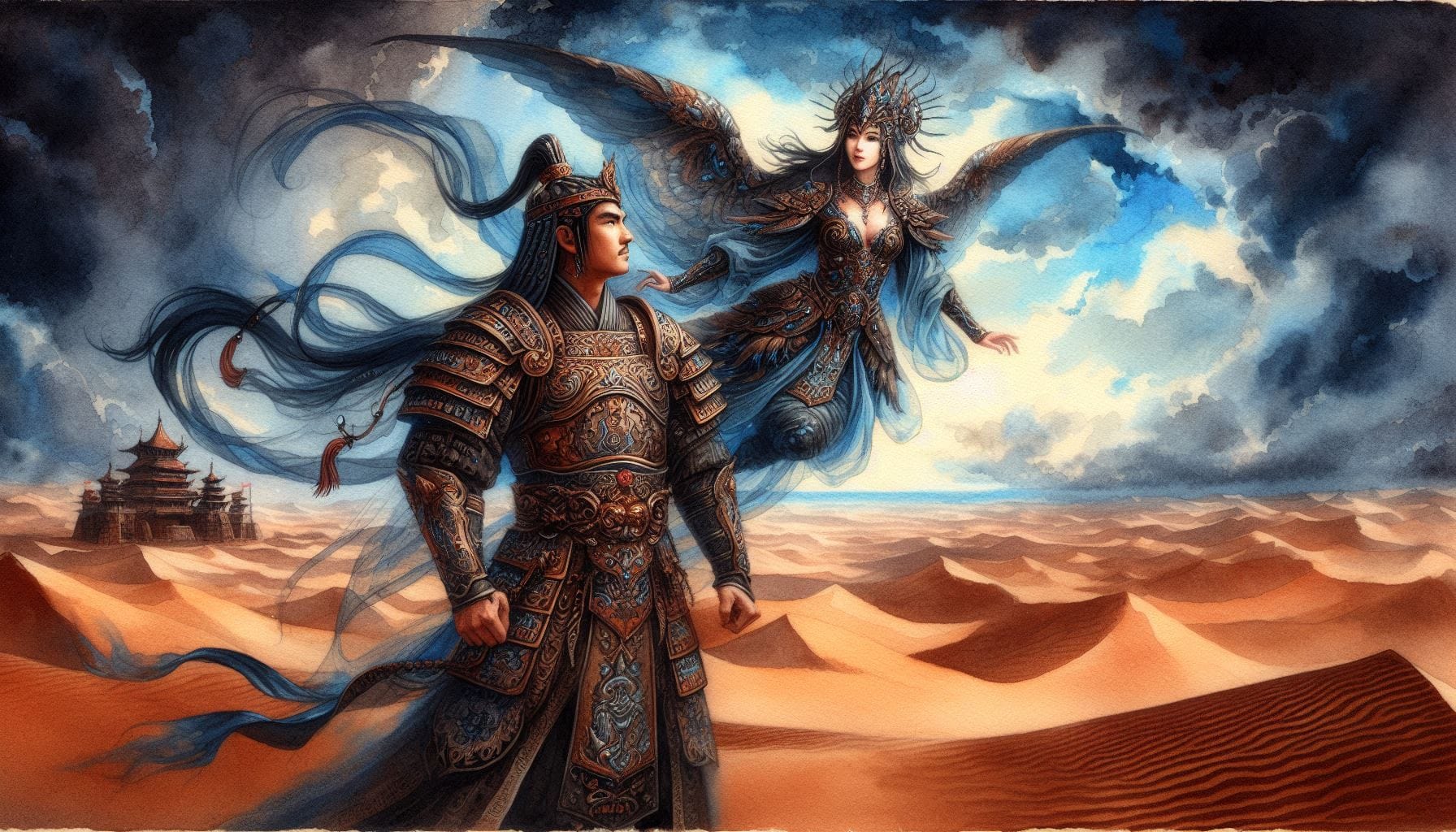
Among all these naked virgins, lesbians, and sadomasochism, we get a single Magic card: the Island of Wak-Wak. We learn that “Waq” is given to “a tree whose branches look like human heads. When the sun rises over them, they all cry out: ‘Waq! Waq! Glory be to God, the Creator!’” (Night 806, p. 213). I looked this up, there’s no real reason here. Except a fun theory that it’s an old name for Japan in Chinese (“Wakoku” or “Wo-kuo”). In other words, it precedes the Nights but doesn’t really have a specific place, like the kingdom of Prester John. Umberto Eco would have liked it.