Welcome

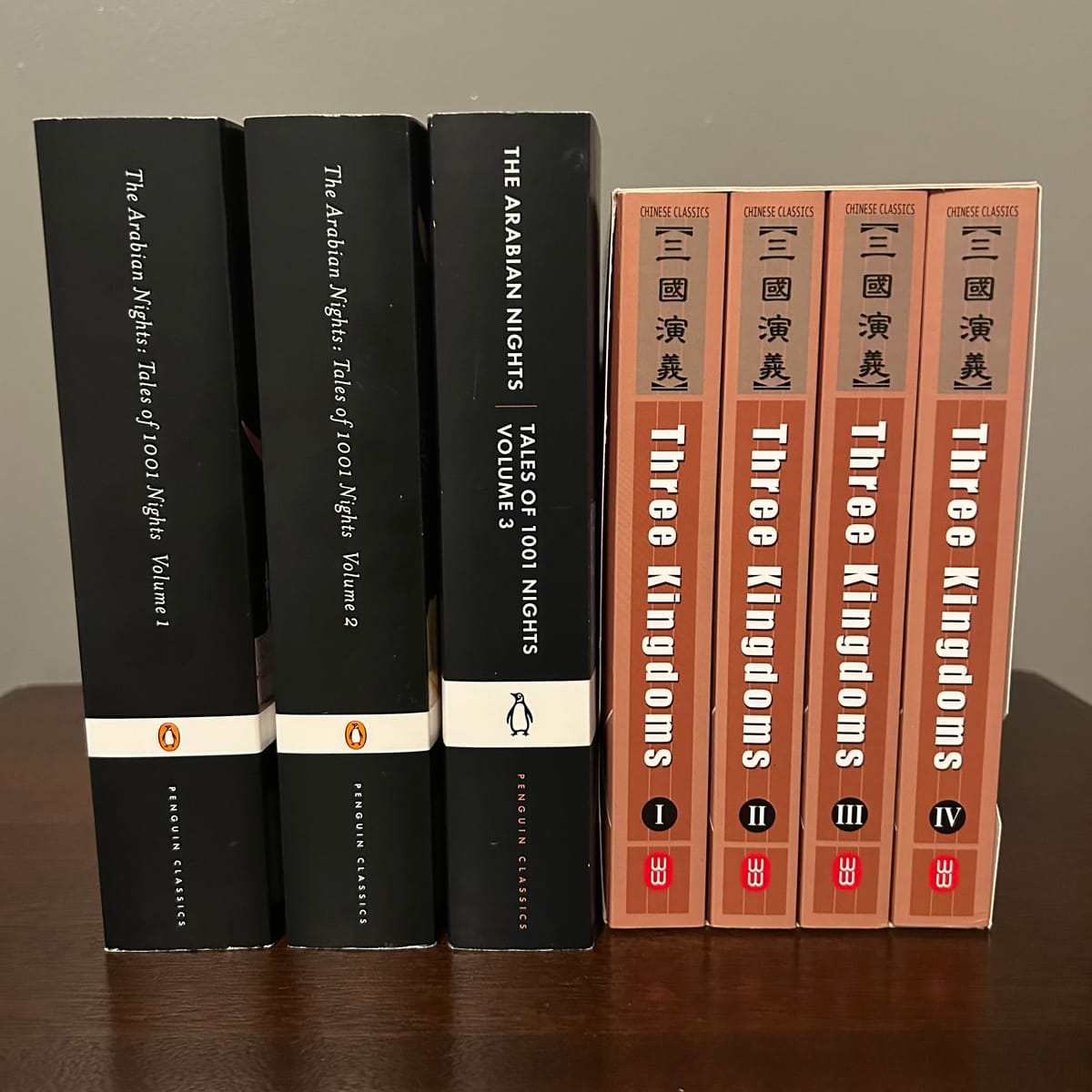
They’re two big books, and both are so long that they require multiple volumes. The first is The One Thousand and One Nights (The Arabian Nights), and the other is the great Chinese classic Romance of the Three Kingdoms. I’ve wanted to read both of them for at least two decades. It’s finally time.
This blog will be a kind of journal as I read through each of them. Interested in joining me? I am confident I will make it through them both over 2026, at which point this blog will be complete. I have a pretty good track record on these reading projects. I’ve done the entire Penguin History of the World, the Golden Legend, and the Bible (twice).
Why these two? Possibly because of all the hours wasted on Magic: the Gathering, and how they introduced me to these books. Two of the “expansion” sets from Magic are based on them. I’m sure my familiarity with The One Thousand and One Nights preceded my knowledge of Magic set (Disney’s Aladdin preceded it, if nothing else). But for Romance of the Three Kingdoms, Magic was certainly my introduction. During and since college, I’ve grown to like the great classics of literature. These two are big ones that I’ve never taken the time to get through. Often when I would see Magic cards associated with these books, I felt compelled to read them.
First, I needed to find the right translations. Let’s start with The One Thousand and One Nights. I’ve tried to find the most “canonical” version possible. My chosen new translation, from Malcolm and Ursula Lyons, is new. It is based on the oldest existing collection, translated into French in 1704-1717 from stories that are centuries older. It has a full one thousand and one chapters, one for each night.
For Romance of the Three Kingdoms, I was convinced to use the Moss Roberts translation after reading about it on one of my favorite book review sites, Fivebooks. It is a full translation of all 120 chapters.
A couple more notes on Romance of the Three Kingdoms, since I imagine readers might not be familiar with it. It was written in the 1660s. It is about a period much earlier, from 180-280 AD or so. It is a far more influential book than The One Thousand and One Nights. You can see all kinds of superlatives about the novel in its Wikipedia page: it’s the greatest Chinese novel, it’s as important as Shakespeare, etc.
Altogether, I’ll have about 50 pages from each book each week, or 100 pages total. I have all sorts of ideas on what I might write about. I’ll write a brief summary, some reactions, and some favorite parts. I’ll try to give a sense of if I am actually enjoying it, and why or why not. For the One Thousand and One Nights in particular, I will try to highlight the best episodes. I’ll include a full schedule in the next post.